Watch a conference demo of ‘Enterprise AI Agents’ and you’ll see magic: autonomous agents writing code, browsing the web, solving business problems on the fly.
Deploy that same agent in a regulated bank, and you’ll see a different outcome: a security incident report.
In a creative agency, this is magic.
In a regulated enterprise environment—banking, insurance, or manufacturing—this is a liability.
The disconnect isn’t about technology; it’s about requirements. Conference demos show agents that improvise creative solutions. Production systems need agents that follow the approved playbook.
We’ve processed 350,000+ enterprise support workflows across insurance, manufacturing, and logistics. The pattern is clear: The future of Enterprise AI isn’t about “General Purpose” agents. It’s about Deterministic Controllers.
Here is why the next generation of AI will be small, sovereign, and intentionally boring.
1. AI Code Generation Security Risk: Why Dynamic Code Execution Fails in Enterprise
There is a dangerous trend in agent frameworks today: giving the AI permission to write and execute its own code to solve problems. The logic seems sound: If the agent encounters a data format it doesn’t recognize, let it write a Python script to parse it.
Security teams have a name for systems that execute arbitrary code: Remote Code Execution (RCE)—a critical vulnerability. Yet agent frameworks market this as “adaptive problem-solving.”
We don’t let engineers push code to production without review, testing, and deployment pipelines. Why are we handing root access to a probabilistic model?
The Enterprise Fix: Select, Don’t Create.
In our architecture, we treat the LLM as a Router, not a Developer.
Our agents don’t write software. They choose from a library of pre-certified, unit-tested functions—each compliance-reviewed and version-controlled.
The LLM’s job is classification, not creation:
-
Input: “Ticket mentions invoice dispute + missing PO number.”
-
Action: Route to validate_po_number()
escalate_to_procurement().
No code generation. No improvisation. No surprises.
2. Enterprise AI Support Automation: Solving the L1 to L2 Handover Problem
Most companies think their problem is “Customer Service”—answering emails faster.
In the enterprise, the real problem is Engineering Capacity.
Level 2 and Level 3 experts are drowning in tickets. Not because they don’t care, but because the data coming from Level 1 is usually garbage: missing transaction IDs, vague descriptions (“System broken”), or screenshots of error logs that nobody transcribed.
A “Chatbot” that just politely replies to the customer creates zero value here.
The Enterprise Fix: The Technical Gatekeeper.
We build agents that act as a firewall for your experts. The agent analyzes the incoming ticket and enforces the “Definition of Ready.”
Real-World Impact:
Across 15,000 technical support workflows we analyzed:
-
67% were missing critical diagnostic data on first submission.
-
Average resolution time: 4.3 days.
-
After implementing gatekeeping validation: 2.1 days.
The AI didn’t solve the tickets faster. It stopped broken tickets from entering the queue.
3. LLM Interface vs. ML Pipeline Intelligence: A Dual Architecture Approach
There is a misconception that the LLM is the “Brain” of the operation. It isn’t. The LLM is the Interface.
The LLM is great at System 1 thinking: Fast, intuitive, conversational.
But it is terrible at System 2 thinking: Statistical analysis, drift detection, and root cause correlation over time. An LLM cannot tell you that “Login Failure 503” is appearing 15% more frequently this week across three different business units.
The Enterprise Fix: Dual Architecture.
We run two systems in parallel:
-
The Interface (LLM): interacts with the human, gathers context, and drafts responses.
-
The Observer (ML Pipeline): runs in the background, clustering topics and detecting anomaly drift.
Example:
An insurance client noticed “Policy Update Failed” tickets spiking. The chatbot was apologizing beautifully to every customer. The ML pipeline caught the root cause: A backend service timeout that affected 3 departments.
The LLM handled the interface. The pipeline prevented 2,000+ repeat failures.
This dual architecture pattern—interface + observer, router + validator—isn’t accidental. It’s systematic.
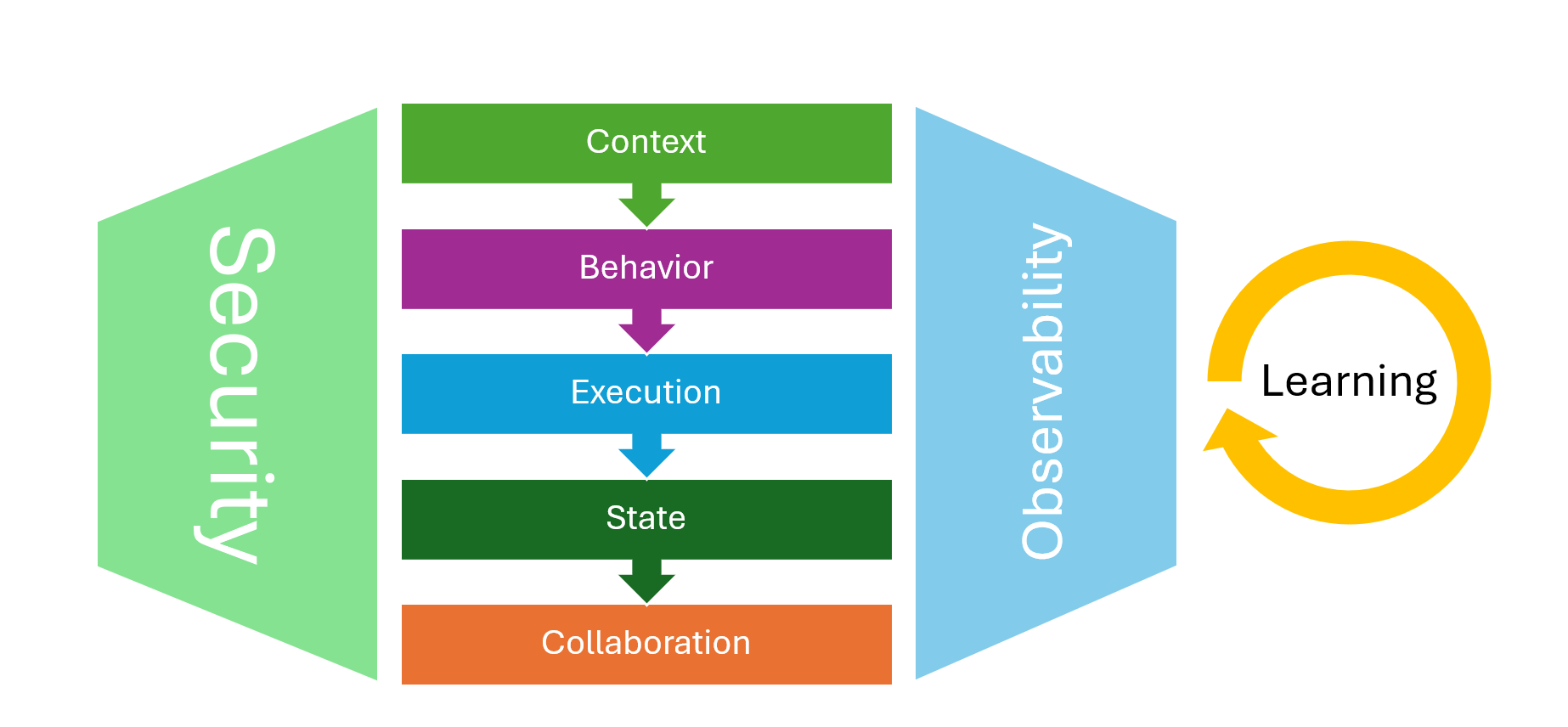
These aren’t isolated fixes. They are layers of a coherent system we call Cognitive Agentic Architecture (CAA).
4. Cognitive Agentic Architecture (CAA): Production AI System Design
These aren’t isolated fixes. They are layers of a coherent system we call Cognitive Agentic Architecture (CAA).
Instead of one giant prompt loop, we break the agent into strict responsibilities to solve specific failure modes:
-
Context Layer validates incoming data schema before the model sees it.
-
Solves: The Handover Problem (enforces "Definition of Ready").
-
-
Behavior Layer generates explicit plans without executing them.
-
Solves: RCE Risk (separation of intent from action).
-
-
Execution Layer runs pre-certified tool contracts with audit trails.
-
Solves: Improvisation (deterministic selection, not creation).
-
-
State Layer persists memory across long-running workflows.
-
Solves: Amnesia (process continuity across days/weeks).
-
This is how production systems survive compliance audits: by architecting boundaries.
5. Data Sovereignty and On-Premise AI: Why Small Language Models Win in Enterprise
Consultants are currently obsessed with “GenAI FinOps”—optimizing the cost per token.
In the enterprise, Cost per Token is a vanity metric.
A CIO doesn’t care if an API call costs $0.01 or $0.05. They care if a critical process is blocked for 1 minute or 1 hour. They care about Cycle Time and Data Sovereignty.
The Enterprise Fix: Sovereign SLMs.
The future belongs to Small Language Models (SLMs) running on-premise or in sovereign clouds.
-
Latency: Sub-second response times for real-time workflows.
-
Privacy: No data leaves your VPC.
-
Safety: Fine-tuned on your SOPs, not the internet.
We aren’t building “Cheaper Chatbots.” We are building Digital Operators that respect the speed and security of your infrastructure.
Conclusion
The next generation of enterprise AI won’t be built by prompt engineers.
It will be built by systems architects who understand state machines over stochastic output, and sovereignty over cloud convenience.
If your organization is evaluating agents that write their own code, you’re optimizing for demos, not production. The companies winning with AI in 2026 are building boring, deterministic controllers.
And they are sleeping well at night.