The Context
After stabilizing automated triage and routing (85% accuracy, 1 FTE/month saved), the manufacturer faced a new challenge: scaling automation across a fragmented process landscape.
Documentation described 70 workflows.
Yet tickets told another story—repeated exceptions, cross-team detours, and mismatched categories hiding operational drift.
Leaders suspected process debt.
Data confirmed it.
They hired us to automate routing. What we found underneath changed how they run the business.
The Challenge
The company’s automation roadmap depended on reliable process documentation — but official SOPs reflected intent, not reality.
Regional variations, informal workarounds, and undocumented exceptions created silent bottlenecks.
Tickets in Germany took 40% longer to close than identical ones in US.
SAP/AD integrations failed inconsistently.
And the same request type followed three different approval paths, depending on who filed it.
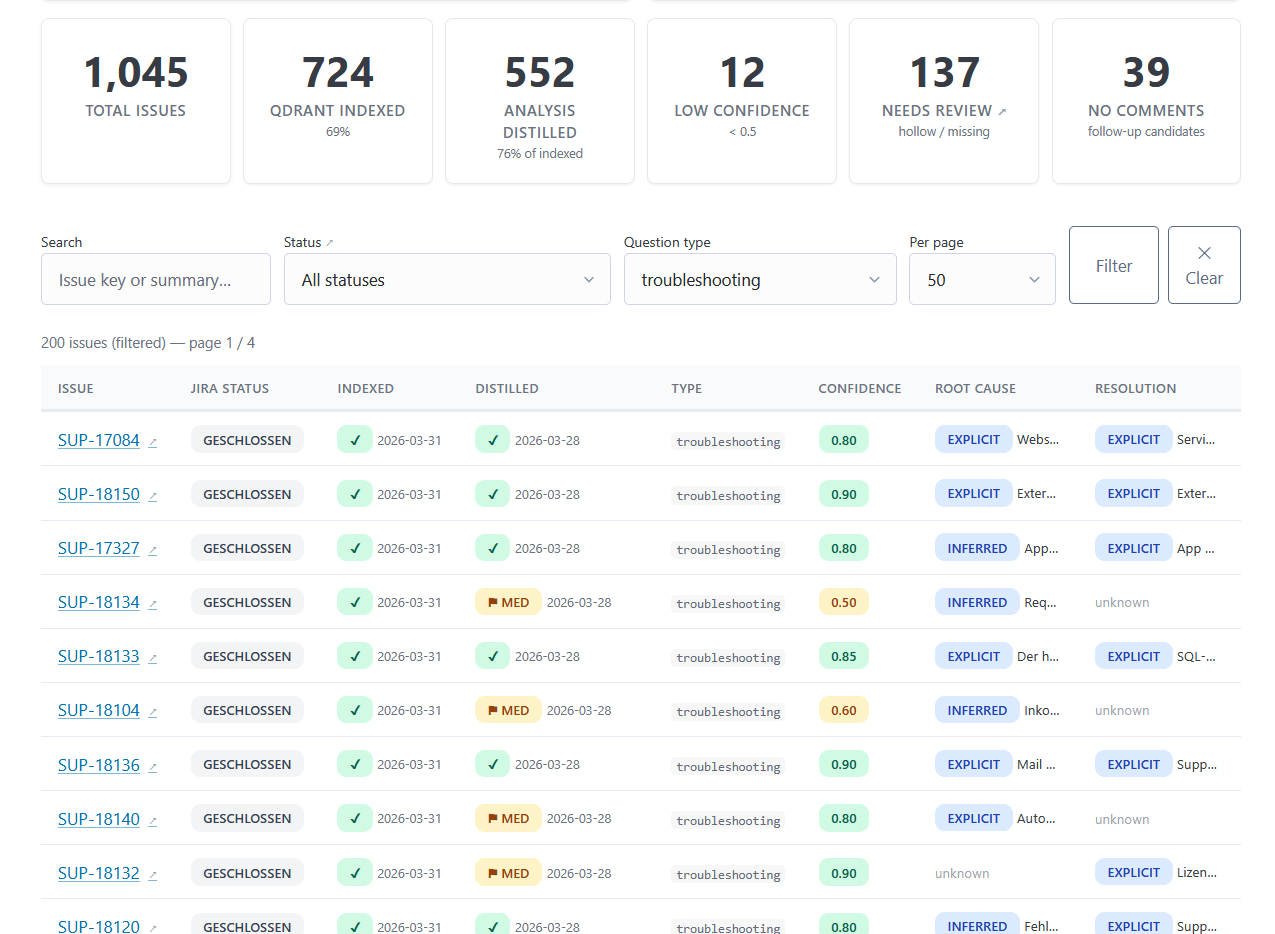
The leadership’s question was simple: “How does work actually flow?” The data held the answer — but buried in 250,000+ unstructured Jira issues.
Our Approach
Arti applied the Knowledge Refinery method to reconstruct actual workflows from raw ticket data:
-
Extracted task sequences, dependencies, and transitions directly from Jira logs
-
Clustered similar patterns using semantic and structural similarity
-
Mapped “shadow” workflows that diverged from official SOPs
-
Visualized gaps between documented and executed processes
The result was a data-driven process map reflecting how work truly happened.
Results
The analysis surfaced far more than undocumented workflows — it revealed how work actually happened.
Arti’s system reconstructed real execution paths, exposing the structural friction buried in daily operations:
-
200+ real workflows uncovered vs. 70 documented
-
Broken approval chains causing geographic delays now visible and corrected
-
SAP/Active Directory integration gaps identified through recurring workaround patterns
-
Reopen and stall patterns traced to missing or misplaced data fields in overloaded Jira forms
-
Workflow-based intake redesign replaced IT-centric forms with adaptive prompts — requesting only the data each workflow truly required
Impact
What emerged wasn’t just cleaner data — it was organizational self-awareness.
Arti turned fragmented Jira history into a single operational map showing how processes evolve, diverge, and fail in the real world.
For the first time, leadership could see exactly:
-
Where approvals stalled
-
How regions diverged
-
Which workflows deserved automation next
The company moved from assumption-driven process design to evidence-based improvement — and built an execution architecture grounded in truth, not documentation.